Five Korean forests, five different stories.
The CANOPY demo workspace holds five example forests of different types: restoration, improved management, urban and conservation. About 3,392 ha in total.
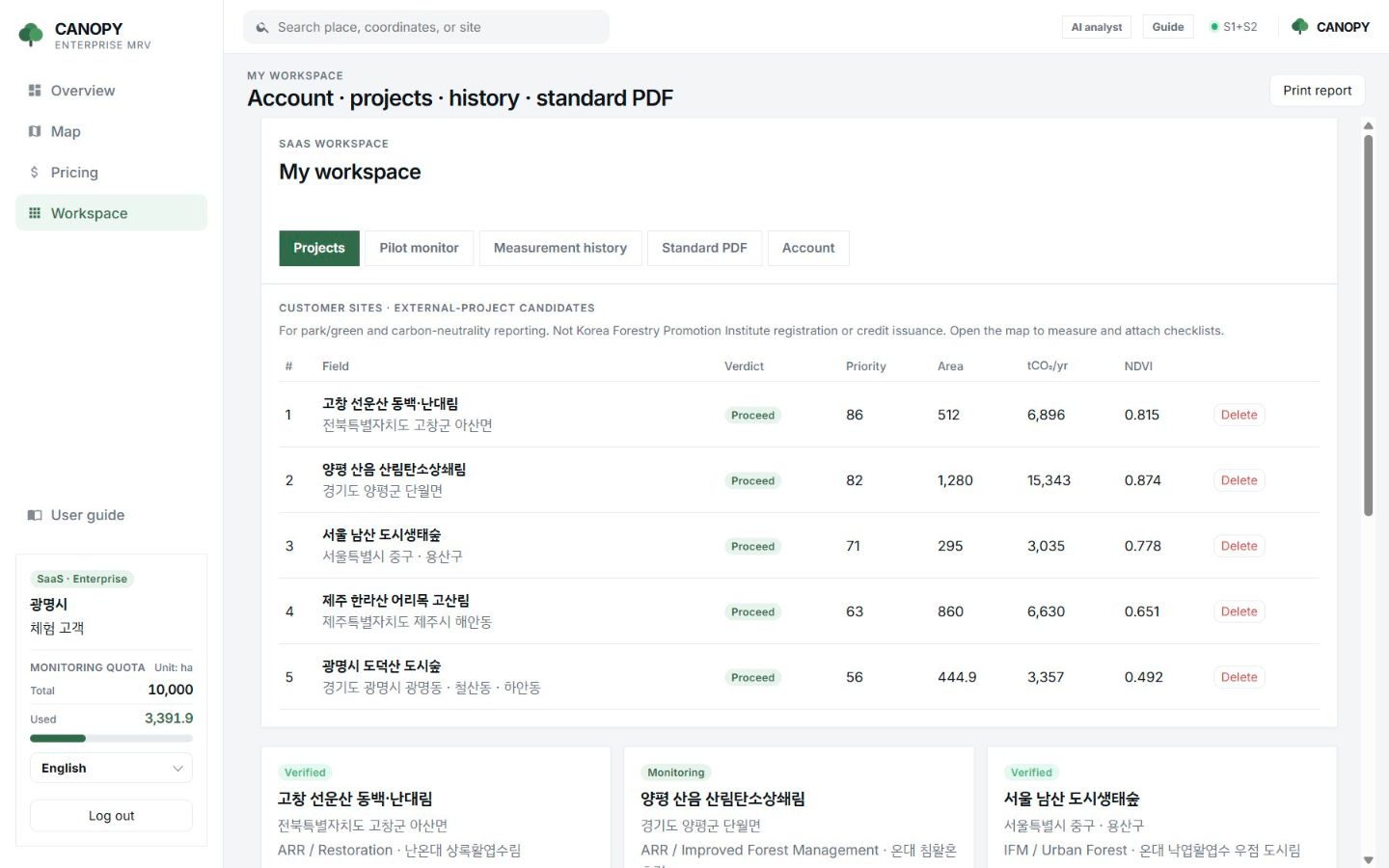
Demo result
All five “proceed”, with different priorities.
On the demo screen (November 2026), all five forests passed the pre-check as “proceed”; uptake density, area, integrity and NDVI separated their priorities.
Demo values
Figures from the demo screen
| Forest | Type | Area (ha) | Annual uptake (tCO₂/yr) | NDVI | Priority |
|---|---|---|---|---|---|
| Gochang Seonunsan camellia and warm-temperate forest | ARR / restoration | 512 | 6,896 | 0.815 | 86 |
| Yangpyeong Saneum forest-carbon offset forest | ARR / improved forest management | 1,280 | 15,343 | 0.874 | 82 |
| Seoul Namsan urban ecological forest | IFM / urban forest | 295 | 3,035 | 0.778 | 71 |
| Jeju Hallasan Eorimok montane forest | REDD+ / conservation | 860 | 6,630 | 0.651 | 63 |
| Gwangmyeong Dodeoksan urban forest | IFM / urban forest conservation | 444.9 | 3,357 | 0.492 | 56 |
Demo data and demo-screen values created by the CANOPY team. They change with measurement date and scene. These are not customer contracts, credit projects or issued credits.
How to read it
The story behind the numbers
Bigger area, bigger total
Yangpyeong Saneum is the largest, so its total annual uptake is the largest. Priority also weighs uptake density.
Low NDVI in the city
Dodeoksan mixes apartments and roads at its edge, so NDVI reads low, and as an urban forest it carries an additionality watch.
Risk in conservation
Eorimok is a conservation type, so permanence signals such as climate and disturbance are watched alongside.
Related pages
Work with us
Start with a satellite screening of your forests.
Send us your forest boundaries. We screen carbon stock, annual uptake and candidate quality from public satellite data first, then walk through the results with you. No field equipment is needed.